Please Choose Your Language
close
Choose Your Site
Global
Social Media
Views: 0 Author: Site Editor Publish Time: 2025-10-23 Origin: Site


In industries such as oil and gas, petrochemical, and power generation, pressure vessels and pipelines are fundamental components for transporting fluids and gases under high pressure. The integrity of these systems is critical—not only for operational efficiency but also for workplace safety. Among the many components that ensure reliability, stud bolts play a vital role. These seemingly simple fasteners are indispensable in maintaining structural integrity, preventing leaks, and ensuring safe operation under demanding conditions.
Stud bolts are threaded rods with no head, designed to be inserted through flanges and secured with nuts on both ends. Unlike standard bolts, which have a head on one end, stud bolts are fully threaded or partially threaded along their length. This design provides several benefits:
Even load distribution: Stud bolts allow for uniform stress along the fastened components.
Ease of installation: With nuts on both ends, components can be pre-aligned before final tightening.
High strength: Designed to withstand high pressure and temperature conditions, especially when made from specialized alloys.
Stud bolts are commonly used in conjunction with flanges, gaskets, and pressure vessel covers, ensuring tight seals and reliable operation.
Stud bolts play a critical role in numerous industrial applications, particularly in sectors where pressure, temperature, and safety are major concerns. Their primary function is to securely fasten flanged joints, maintain structural integrity, and prevent leaks in high-pressure systems. Let’s take a closer look at the key applications where stud bolts are indispensable.
Pressure vessels are enclosed containers engineered to hold gases or liquids at high pressures, often exceeding hundreds or thousands of PSI (pounds per square inch). They are extensively used in industries such as chemical processing, petrochemical refining, power generation, and storage systems for compressed gases. The reliability of pressure vessels is paramount, as any failure can lead to catastrophic accidents, environmental damage, and significant financial loss.
Flanged connections on pressure vessels are particularly critical because they allow access for maintenance, inspections, or installation of safety equipment. Stud bolts ensure that these flanges remain securely fastened under extreme conditions. Specifically, they provide:
Secure flange connections: By maintaining uniform compression on gaskets, stud bolts prevent fluid or gas leaks. Proper gasket compression is essential to avoid pressure loss or hazardous release.
Resistance to vibration and dynamic forces: Pressure vessels often experience fluctuating pressures and operational vibrations. High-quality stud bolts reduce the risk of loosening, which can compromise system integrity.
Structural integrity under high stress: Stud bolts help the vessel withstand internal pressure without deformation or flange separation. Their high tensile strength distributes stress evenly across the joint, reducing weak points.
In addition to holding the vessel components together, stud bolts simplify maintenance. Technicians can remove nuts from both ends of the bolt without damaging the vessel, making inspections and part replacements safer and more efficient.
Pipelines are the backbone of transporting fluids such as oil, gas, chemicals, and water over long distances. In such systems, flanged joints are critical points connecting pipes, pumps, valves, and other equipment. Stud bolts in pipeline applications serve several vital purposes:
Leak prevention: By firmly clamping flanges together and compressing gaskets evenly, stud bolts prevent leaks of hazardous or costly materials. This ensures operational safety and environmental compliance.
Durability under pressure fluctuations: Pipelines often experience pulsating flows or pressure surges. Stud bolts manufactured from high-strength alloys resist fatigue and maintain consistent performance even under cyclic loading.
Safe maintenance and disassembly: Pipelines require regular inspection and occasional replacement of components. Stud bolts allow flanges to be disassembled and reassembled without damaging the piping, providing flexibility and reducing downtime.
Additionally, pipelines may traverse harsh environments—sub-zero temperatures, high humidity, or corrosive conditions—making stud bolts’ material selection and durability critical to long-term reliability.
Stud bolts are equally important in assembling heat exchangers, boilers, and industrial valves, where temperature variations, thermal expansion, and vibration are common challenges. In these systems, the clamping force provided by stud bolts maintains the integrity of gaskets and seals:
Thermal resilience: As equipment heats up and cools down, expansion and contraction can loosen connections. Properly designed and tightened stud bolts compensate for these changes and maintain consistent compression.
Vibration resistance: Industrial pumps, compressors, and valves generate significant vibration. Stud bolts help prevent flange separation and maintain alignment over extended operational periods.
Pressure endurance: Heat exchangers and boilers operate under varying pressures. High-quality stud bolts ensure safe containment of fluids and gases, reducing the risk of leaks, equipment damage, and operational downtime.
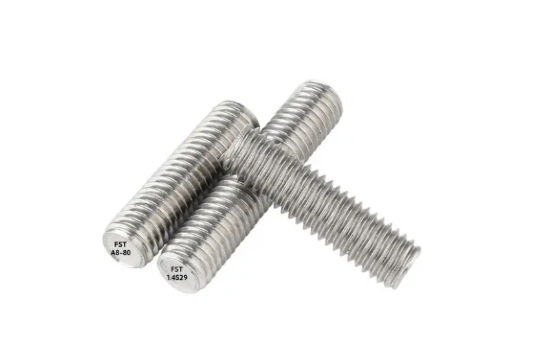
The choice of material is critical for the performance and longevity of stud bolts, as they must endure mechanical, thermal, and chemical stresses. Common materials include:
Carbon steel: Often used in standard applications with moderate pressure and temperature. Provides cost-effective performance but limited corrosion resistance.
Alloy steel: Offers higher tensile strength, toughness, and fatigue resistance. Ideal for high-pressure applications in petrochemical or industrial settings.
Stainless steel: Resists corrosion and oxidation, making it suitable for marine environments or chemically aggressive conditions. Common grades include 304 and 316 stainless steel.
Nickel and chromium alloys: Used in extreme high-temperature, high-pressure, or chemically aggressive environments. These materials provide exceptional strength and durability in the most demanding industrial applications.
Each material is available in different grades that define mechanical properties such as tensile strength, yield strength, hardness, and elongation. Selecting the correct material and grade ensures that the stud bolts can reliably handle operational conditions, maintain safety, and prolong the service life of pressure vessels and pipelines. Furthermore, choosing the right grade minimizes maintenance needs and prevents costly downtime caused by bolt failure or flange leakage.
Designing a stud bolt connection involves more than just choosing the material. Engineers must consider:
Thread type: Coarse threads for easy assembly; fine threads for higher tensile strength.
Bolt length: Long enough to accommodate flange thickness and gasket compression, but not excessive to avoid bending stresses.
Preload and torque specifications: Proper tightening ensures the desired clamping force, reduces stress concentration, and prevents gasket blowout.
Temperature and pressure ratings: High-pressure or high-temperature applications may require specialized studs with enhanced creep and fatigue resistance.
Failure to consider these factors can result in leaks, equipment damage, or catastrophic failure of the system.
Stud bolts are central to operational safety in high-pressure systems. Their role in preventing accidents cannot be overstated:
A poorly selected or improperly tightened stud bolt can lead to flange leakage, which may cause hazardous fluid release, environmental contamination, or operational shutdowns.
Pressure vessels and pipelines undergo cyclic stresses from internal pressure fluctuations, thermal expansion, and mechanical vibration. Stud bolts help maintain joint integrity by evenly distributing loads and resisting loosening.
Stud bolts are manufactured to meet international standards such as:
ASME B16.5: Flanged fittings and bolt dimensions for piping systems.
ASTM A193 / A194: Material specifications for high-strength bolts and nuts.
ISO 898-1: Mechanical properties of fasteners.
Compliance ensures that the bolts can withstand expected operating conditions and are suitable for critical applications.
Proper installation and regular maintenance of stud bolts are crucial to system safety:
Use Torque Wrenches: Ensure each bolt is tightened to the specified torque to achieve uniform preload.
Apply Lubrication: Anti-seize compounds can reduce friction, preventing overstressing during tightening.
Use Washers Where Required: Distributes load evenly and prevents damage to flange surfaces.
Inspect Regularly: Periodic inspection for corrosion, elongation, or loosening helps detect issues before failure occurs.
Replace Damaged Bolts: Do not reuse bolts that show signs of fatigue, thread wear, or surface corrosion.
Following proper installation and maintenance protocols ensures long-term reliability and operational safety.
Enhanced Safety: Prevents leaks, blowouts, and joint failure.
Operational Reliability: Supports continuous operation in high-pressure environments.
Cost Savings: Reduces downtime and maintenance costs associated with bolt or gasket failure.
Compliance: Meets regulatory and industry standards for critical applications.
Investing in high-quality stud bolts is an investment in the safety and efficiency of industrial systems.
Stud bolts may seem like small components, but their impact on pressure vessel and pipeline safety is immense. By providing secure, reliable connections under extreme conditions, they prevent leaks, ensure structural integrity, and help facilities comply with industry standards. Proper material selection, installation, and maintenance of stud bolts are essential for safe and efficient operations in sectors ranging from petrochemical and oil & gas to power generation and water treatment.
For businesses looking for reliable, high-quality stud bolts and professional guidance, www.jsfastool.com offers a wide range of products designed for critical applications. Contact them today to explore solutions that ensure your pressure vessels and pipelines remain safe, efficient, and compliant.