Please Choose Your Language
close
Choose Your Site
Global
Social Media
Views: 0 Author: Site Editor Publish Time: 2026-08-06 Origin: Site


Duplex nuts are threaded fasteners manufactured from duplex stainless steel, a family of alloys that combines ferritic and austenitic phases in the metal structure. This balanced microstructure gives the material a useful combination of high mechanical strength, resistance to chloride stress corrosion cracking, and better localized corrosion performance than many conventional stainless steels. For engineers and purchasing teams, the term does not describe one universal nut. It covers several grades, dimensions, thread systems, nut styles, and property classes selected for a specific bolted joint and service environment.
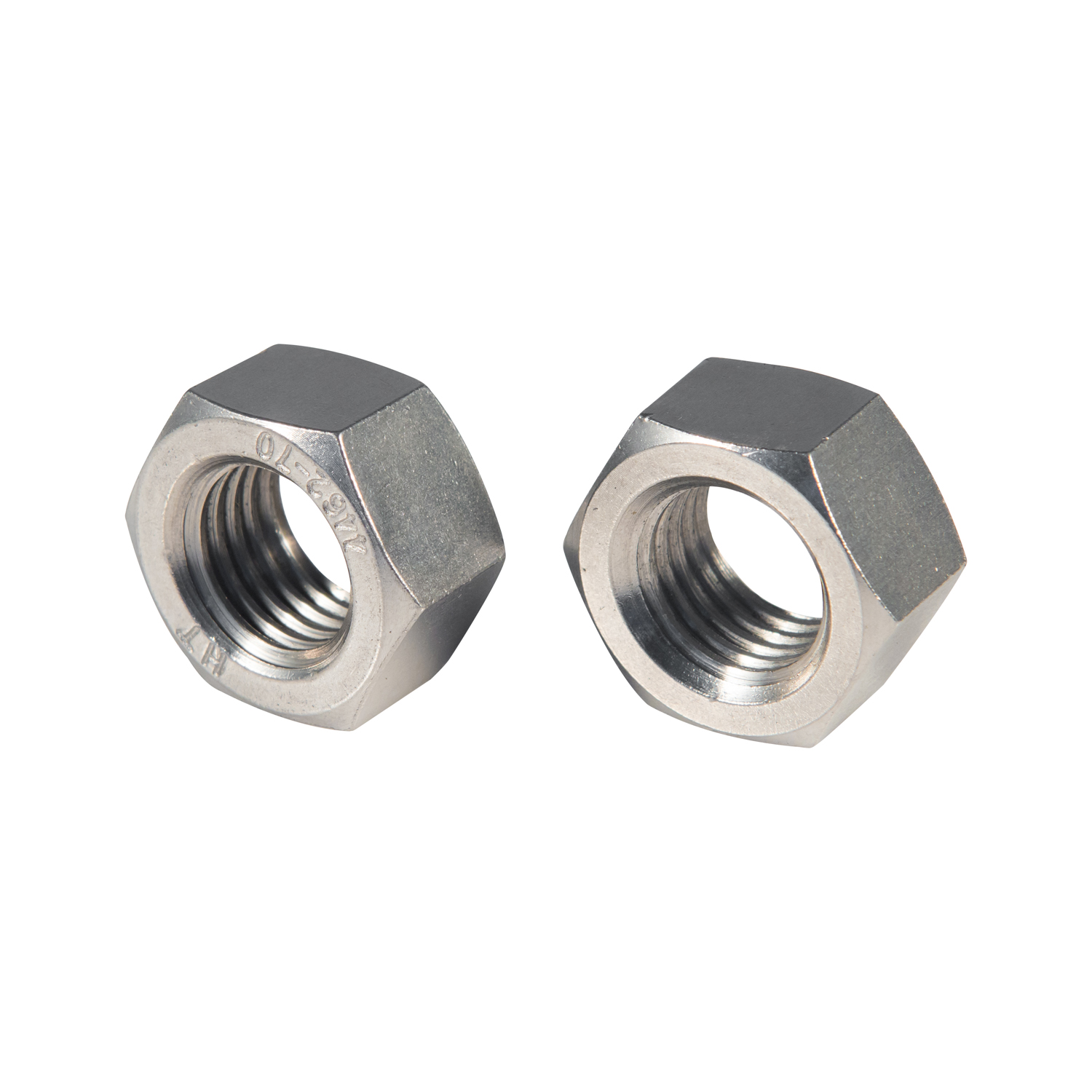
The defining feature of duplex stainless steel is its mixed microstructure. Austenitic stainless steels such as 304 and 316 are primarily austenitic, while ferritic grades are primarily ferritic. Duplex grades are produced to contain substantial amounts of both phases. The ferritic portion contributes strength and resistance to chloride-induced stress corrosion cracking, while the austenitic portion supports ductility and toughness. Proper chemical composition and heat treatment are necessary to maintain this balance.
Chromium creates the passive surface film that allows stainless steel to resist general corrosion. Molybdenum and nitrogen improve resistance to pitting and crevice corrosion, particularly in chloride-bearing environments. Nickel helps stabilize the austenitic phase. Because these elements are controlled within grade-specific ranges, a nut described only as “duplex” is not sufficiently specified for procurement. The exact grade must appear on drawings, purchase orders, inspection records, and material certificates.
Duplex 2205 is the most widely used grade in the family. It is commonly referenced by UNS S31803 or UNS S32205 and by the European material number 1.4462. S32205 has tighter minimum requirements for chromium, molybdenum, and nitrogen than the original broad S31803 range, although both designations are associated with the commercial name 2205.
Super duplex 2507, commonly identified as UNS S32750 or 1.4410, contains higher levels of chromium, molybdenum, and nitrogen. It is selected when localized corrosion resistance must exceed the capability of standard 2205. Other super duplex grades, including UNS S32760 or 1.4501, may be specified for particularly severe chemical, offshore, or cooling-water duties. Grade choice should always follow the project corrosion study rather than a simple assumption that the most highly alloyed option is automatically necessary.
A nut converts rotational tightening into axial tension in a bolt or stud. That axial tension creates clamp force between the joined components. The reliability of the connection depends on more than the nut material. Thread form, thread tolerance, nut height, bearing-face condition, washer selection, lubrication, tightening method, and the strength of the mating bolt all influence performance.
The nut must be strong enough to develop the required preload without stripping its internal threads or suffering excessive bearing deformation. In many correctly designed joints, the bolt or stud is intended to be the more predictable limiting component. Using a high-strength duplex nut on a weaker or incompatible bolt can create thread damage, galvanic concerns, or an unsuitable torque-preload relationship. For that reason, nuts, bolts, studs, and washers should be specified as a fastening system.
Hex nuts are the most common form because they are easy to install with standard tooling. Heavy hex nuts provide greater width across flats and additional bearing area for high-load flange and structural connections. Coupling nuts join two threaded rods or studs and require adequate engagement on both sides. Thin nuts may be used as jam nuts or in space-restricted assemblies, but their reduced height changes the available thread engagement and proof-load capability.
Cap nuts protect exposed thread ends and can improve safety or cleanliness in selected assemblies. Flange nuts provide an integrated bearing surface, while custom machined nuts may incorporate special dimensions, fine threads, locking features, drilled holes, or project-specific profiles. The drawing and applicable dimensional standard should define the geometry instead of relying on a generic product name.
Duplex nuts are most valuable when a bolted joint faces both mechanical load and a corrosive operating environment. They are not limited to submerged seawater service. Many installations involve chloride-bearing cooling water, wet process chemicals, salt aerosols, acidic contaminants, temperature cycling, or difficult maintenance access. In these conditions, the consequences of fastener failure may include leakage, shutdown, structural damage, or safety risk.
Water treatment plants use bolted connections on pumps, valves, pipe supports, strainers, pressure vessels, filter equipment, and chemical dosing systems. Chloride concentration may rise through evaporation, membrane concentration, or brine handling. Duplex 2205 is often considered for moderate chloride duties, while super duplex grades are evaluated for warmer raw seawater, high-pressure reverse-osmosis equipment, brine streams, and crevice-prone connections.
Fastener selection must reflect the actual zone of the plant. A nut in a dry indoor utility area faces a different risk from a nut in a permanently wet flange, a splash zone, or a high-chloride concentrate line. Designers should also consider gasket chemistry, cleaning agents, stagnant conditions, and whether deposits can trap moisture around the threads.
Cooling towers expose fasteners to water, dissolved salts, treatment chemicals, humidity, and repeated wet-dry cycles. Nuts may be used in fan assemblies, structural frames, piping, drift eliminators, pumps, platforms, and heat-exchange systems. Duplex material can provide a longer service life than lower-alloy stainless steel when chlorides and crevices make localized corrosion the controlling failure mode.
Power projects also require reliable documentation and lot traceability because the fasteners may be installed in safety-relevant or difficult-to-access locations. A project specification may call for material certificates, positive material identification, dimensional inspection, proof-load testing, and controlled marking. These requirements should be agreed before production, not requested only after goods are ready to ship.
Chemical plants use duplex fasteners on pipe flanges, valves, reactors, storage systems, heat exchangers, scrubbers, and process skids. The alloy may resist certain chloride-containing and acidic environments better than common austenitic stainless steels, but compatibility cannot be determined from the word “chemical” alone. Concentration, temperature, contaminants, aeration, flow, shutdown conditions, and cleaning procedures all affect corrosion behavior.
Offshore platforms, coastal infrastructure, marine equipment, and seawater handling systems create persistent chloride exposure. Super duplex nuts may be used on high-pressure piping, pumps, valves, seawater injection systems, riser equipment, and corrosion-resistant structures. However, seawater performance depends strongly on temperature, oxygen availability, flow, crevice geometry, deposits, and cathodic protection conditions.
Atmospheric coastal exposure can also be severe because salt deposits concentrate during drying. A fastener may corrode even when it is not submerged. Good drainage, accessible inspection, compatible washers, and avoidance of contamination during installation are therefore important parts of the design.
The most immediate difference is strength. Duplex 2205 generally offers substantially higher proof or yield strength than conventional 316 stainless steel product forms. This can support high-load joints and may permit more efficient component design, although a smaller fastener should never be selected without a complete joint calculation.
The second advantage is improved resistance to chloride stress corrosion cracking. Duplex grades also provide stronger pitting and crevice corrosion resistance, with super duplex alloys extending the usable range further. These benefits are especially relevant to nut threads, where narrow gaps, deposits, and limited oxygen can create crevice-like conditions.
Duplex is not always the best economic choice. In mild indoor environments, 304 or 316 may be adequate and easier to source. In very aggressive chemical or high-temperature duties, a nickel alloy may be more appropriate. Material selection should compare lifecycle risk, availability, fabrication, inspection, maintenance access, and the cost of failure.
A complete specification begins with the material grade and the standard or drawing that controls dimensions. It should define metric or inch threads, nominal diameter, pitch or threads per inch, thread tolerance or class, nut style, width across flats, nut height, finish, and marking. The required property class or mechanical requirements should be identified separately from the alloy name.
ISO 3506-2 covers mechanical and physical properties for corrosion-resistant stainless steel nuts within its stated scope and includes duplex steel grades and property classes. Dimensional standards may include ISO or DIN hex-nut standards, ASME standards for inch-series nuts, or customer drawings. Material requirements may be linked to ASTM, ASME, EN, NORSOK, or project-specific specifications depending on the industry.
An EN 10204 3.1 inspection certificate is commonly requested to document material chemistry and test results, but the certificate alone does not prove that every project requirement has been met. The purchaser should verify that the heat number on the certificate corresponds to the product marking or packaging and that the reported tests match the ordered specification.
Duplex stainless steel threads can gall when high contact pressure, friction, and sliding damage the passive surface. Clean threads, correct alignment, controlled tightening speed, and a project-approved lubricant or anti-seize compound can reduce the risk. Lubrication changes the relationship between torque and preload, so a dry torque value must not be reused without adjustment.
Installers should reject damaged, contaminated, or mismatched threads. Nuts should run freely by hand for several turns before final tightening. Powered tools should be used with controlled speed, especially during initial engagement. For critical joints, the tightening procedure should specify sequence, passes, calibrated equipment, target preload or torque, and acceptance criteria.
Duplex nuts are high-performance fastening components for joints that require greater strength and corrosion resistance than many standard stainless steel options can provide. Duplex 2205 serves a broad range of water, chemical, structural, and process applications. Super duplex grades are reserved for more aggressive chloride conditions, higher localized-corrosion risk, or project specifications that demand additional margin.
The correct product is determined by the complete bolted-joint requirement: material grade, mechanical class, nut geometry, mating fastener, environment, temperature, tightening method, certification, and inspection. FASTOOL manufactures standard and customized corrosion-resistant fasteners for project applications, including duplex and super duplex nuts, bolts, studs, and related components. Buyers can provide drawings, standards, material requirements, and service conditions so that the supplied fastening package is aligned with the intended installation.