Please Choose Your Language
close
Choose Your Site
Global
Social Media
Views: 0 Author: Site Editor Publish Time: 2026-06-22 Origin: Site


Extreme industrial environments demand flawless hardware performance where failure is simply not an option. Offshore drilling rigs expose infrastructure to relentless ocean spray. Desalination plants subject equipment to highly concentrated brine solutions. Standard stainless steel fasteners regularly fail prematurely under these brutal conditions. Pitting and chloride stress corrosion cracking destroy conventional hardware rapidly. These failures risk catastrophic structural breaches across vital facilities.
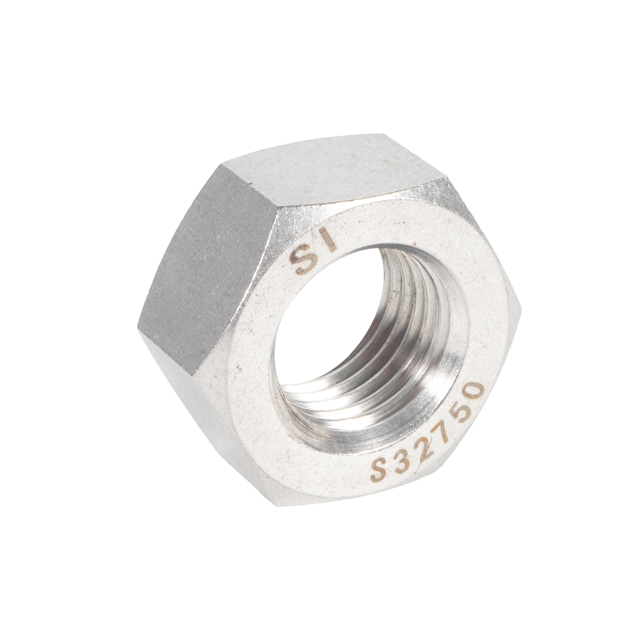
To combat this exact problem, engineers rely heavily on the Super Duplex 2507 Nut. We define this severe-service fastening component as a high-strength solution. Manufacturers design it specifically for aggressive, high-chloride chemical conditions. This article provides you with a comprehensive engineering and procurement framework. You will learn exactly how to specify, source, and install these advanced fasteners safely. We will help you maintain maximum structural integrity without over-speccing your project parameters.
A Super Duplex 2507 nut (standardized as a UNS S32750 nut) offers exceptionally high resistance to localized corrosion, boasting a PREN (Pitting Resistance Equivalent Number) strictly above 42.
It delivers nearly double the yield strength of conventional 300-series stainless steel nuts, allowing for potential weight and size reductions in assembly designs.
The material is ideal for marine, petrochemical, and desalination applications but has strict temperature limitations (loses toughness above 600°F/315°C and below -58°F/-50°C).
Installation requires deliberate anti-galling mitigation due to the material's inherent friction characteristics.
Understanding the fundamental metallurgy reveals exactly why this hardware survives extreme punishment. The atomic structure directly dictates physical performance in the field. Engineers must grasp these chemical fundamentals to make safe material selections.
The term "duplex" refers to a highly specific dual-phase metallurgical state. The microstructure blends austenite and ferrite phases in a roughly 50/50 ratio. This careful balance provides incredible advantages. Austenite grants the metal excellent ductility and impact resistance. Ferrite delivers immense mechanical strength and structural rigidity. Mixing them perfectly stops internal crack propagation dead in its tracks.
Creating this dual-phase structure requires a highly controlled chemical recipe. The defining elemental makeup includes exactly 25% Chromium. This massive chromium content forms a robust passive oxide layer instantly. The mixture also contains 7% Nickel and 4% Molybdenum. Molybdenum acts as the primary defender against aggressive pitting attacks. High nitrogen additions further stabilize the austenite phase during cooling.
Standard naming conventions often confuse procurement departments. Global supply chains use several designations interchangeably. Specifying a UNS S32750 nut means you are legally requesting 2507 alloy. UNS stands for Unified Numbering System. This system ensures chemical consistency across different global manufacturers. You might also see it designated as EN 1.4410 in European markets.
PREN stands for Pitting Resistance Equivalent Number. Engineers use this mathematical metric to predict corrosion resistance accurately. A baseline score strictly above 42 guarantees reliable performance inside chloride-rich environments. Anything scoring below 40 cannot legally carry the "super" prefix. We calculate it using a standard metallurgical formula focusing on specific protective elements.
PREN Calculation Formula and Material Benchmarks | ||
Metric Element | Standard Formula | Average PREN Score |
|---|---|---|
Formula Base | %Cr + 3.3(%Mo) + 16(%N) | N/A |
Super Duplex 2507 | 25 + 3.3(4) + 16(0.28) | 42 - 43 |
Standard 316L | 16 + 3.3(2) + 16(0) | ~24 |
Theoretical chemistry only matters if it translates to field reliability. This specialized hardware undergoes rigorous mechanical testing. We must examine exact performance thresholds to guarantee industrial safety. Understanding these tolerances prevents disastrous engineering miscalculations.
Standard fastener grades simply cannot match these mechanical properties. The typical tensile strength reaches approximately 116 ksi (800 MPa). Tensile strength measures the absolute maximum pulling force before structural fracture. Yield strength hits roughly 80 ksi (550 MPa). Yield strength indicates exactly when permanent plastic deformation begins. This remarkable strength allows engineers to design smaller, lighter joints.
This alloy dominates specific chemical threat vectors. We must highlight its exact resistance capabilities against different degradation types.
Chloride Stress Corrosion Cracking (SCC): High temperatures and salts usually shatter standard stainless steel. The ferritic phase entirely neutralizes this cracking mechanism.
Crevice Corrosion: Tight assembly joints trap stagnant, corrosive agents easily. The 4% molybdenum content severely restricts crevice attacks under washers.
General Acidic Corrosion: Industrial processing plants utilize harsh chemicals daily. This alloy easily withstands moderate concentrations of sulfuric and hydrochloric acids.
Responsible engineering requires extreme transparency regarding material weaknesses. You must acknowledge realistic thermal boundaries. This specific alloy is absolutely not a high-heat material. Prolonged exposure above 315°C (600°F) triggers a dangerous metallurgical shift. Experts call this the "475°C embrittlement" phenomenon. The metal rapidly loses impact toughness and becomes glass-like. Sub-zero applications also face strict physical limits. The crystalline structure loses vital ductility below -58°F (-50°C).
Specifying materials requires careful balancing of physical durability and maintenance intervals. Engineers frequently struggle to optimize replacement frequency. Selecting the wrong grade guarantees continuous maintenance shutdowns. We need a clear evaluation matrix for upgrading decisions.
Standard 316L represents the baseline for marine environments. It performs adequately in cool, moderately saline conditions. The threshold for failure drops rapidly as temperatures rise. Warm, high-chloride environments destroy 316L threads quickly. Pitting eats through the fastener walls within months. Upgrading becomes absolutely mandatory for basic site safety. You cannot rely on 316L inside highly pressurized desalination pumps.
Choosing between these two dual-phase alloys requires distinct shortlisting logic. Moderate chloride environments allow standard 2205 usage safely. It handles basic offshore splash zones adequately. Extreme salinity demands the immediate 2507 upgrade. High temperatures and acidic washdowns also dictate strictly using the super-grade variant. You must evaluate the peak environmental harshness accurately.
Engineering Material Comparison Matrix | |||
Material Grade | PREN Range | Yield Strength (Approx.) | Primary Use Case Scenario |
|---|---|---|---|
316L Stainless | 23 - 28 | 30 ksi (205 MPa) | Basic weatherproofing, light marine topside use. |
Duplex 2205 | 34 - 36 | 65 ksi (450 MPa) | Moderate chloride exposure, standard offshore platforms. |
Super Duplex 2507 | 42 - 43 | 80 ksi (550 MPa) | Subsea pressure joints, desalination brine heaters. |
Procuring specialized severe-service fasteners requires exact specification language. Vague purchase orders lead to disastrous field failures. Buyers must enforce strict international manufacturing standards. Supply chains demand precise documentation for these exotic alloys.
Buyers must explicitly specify exact dimensional guidelines on every order. Ambiguous dimensions cause catastrophic assembly delays. You should request ASME B18.2.2 standards for American heavy hex applications. European metric systems usually dictate DIN 934 or ISO 4032 standards. These codes guarantee exact wrench clearances and thread engagement lengths.
Exotic alloys face significant market availability constraints. Coarse threads (UNC or standard metric) represent the readily available industry norm. Fine threads (UNF) present distinct manufacturing challenges. Machining fine pitches into this incredibly hard material wears tools rapidly. You will usually encounter custom machining requirements for fine threads. Always expect significantly longer lead times for non-standard pitches.
Strict compliance verification remains absolutely non-negotiable for critical infrastructure. Procurement teams must formally request EN 10204 3.1 Material Test Reports (MTRs). You must review these documents prior to physical batch acceptance. These certificates verify the exact chemical composition poured at the mill. They also document the precise mechanical properties achieved during final heat treatment.
Successfully sourcing the hardware only solves half the engineering puzzle. Installation procedures dictate long-term joint survival. Poor assembly techniques destroy expensive materials instantly. Field mechanics must understand the specific friction characteristics involved.
Thread galling poses a notorious and frequent implementation risk. Mechanics often refer to this disaster as "cold welding." It happens frequently when mating identical premium alloys under severe torque. The extreme friction strips away the microscopic protective oxide layer. Bare metal surfaces grind together violently. The male and female threads fuse together permanently into a solid lump. You must cut the bolt to remove it.
Field prevention strategies determine total installation success. You must enforce these rules strictly.
Mandatory Lubrication: Dry installations guarantee immediate galling failure. You must mandate premium anti-seize pastes on every thread. Nickel-based or moly-disulfide options perform exceptionally well.
Installation Speed Control: High-speed pneumatic impact wrenches generate excessive, sudden friction heat. You must use slow, controlled RPMing devices instead. Manual torque wrenches prevent dangerous localized temperature spikes.
Hardness Differentials: Consider creating a slight metallurgical hardness variance. You can sometimes use a slightly harder bolt than the mating receiver. This engineering practice minimizes fusion risks during heavy tightening.
Best Practice: Always hand-thread the first three to four complete turns. This simple step ensures perfect alignment and distributes initial lubrication evenly.
Common Mistake: Ignoring lubrication on the load-bearing washer face. Friction occurs beneath the hardware base just as severely as inside the threads.
Specifying a high-performance nut represents a direct investment in critical lifecycle reliability. You cannot compromise on structural integrity inside aggressive chemical environments. This specific dual-phase alloy prevents disastrous infrastructure failures where standard stainless steel simply disintegrates.
Your immediate next steps should focus on rigorous data gathering before procurement.
Map out your exact maximum and minimum operational temperature exposures accurately.
Identify peak chloride concentrations and acidity levels within your specific process environment.
Confirm all necessary dimensional requirements, choosing clearly between ASME or DIN standards.
Demand EN 10204 3.1 certification from every potential vendor.
Contact specialized exotic alloy fastener manufacturers armed with these verified engineering parameters.
A: Technically yes, but experts strongly advise against it. Mixing these alloys introduces a severe risk of galvanic corrosion. The structural joint will only be as strong and corrosion-resistant as the weaker 316 bolt. You entirely lose the primary mechanical benefits of the premium fastening component.
A: Yes, it is notably magnetic. The material features a roughly 50% ferritic microstructure. This differs significantly from fully austenitic grades like 304 or 316, which generally remain non-magnetic. Field engineers frequently use magnetism as a quick, initial verification test during hardware inspections.
A: Reusability depends entirely on thread condition after removal. Exotic alloys face high risks of micro-galling and severe deformation under heavy torque. Re-tapping or reusing these fasteners in critical-load applications is universally discouraged. You should mandate rigorous non-destructive inspection if reuse is absolutely unavoidable.