Please Choose Your Language
close
Choose Your Site
Global
Social Media
Views: 0 Author: Site Editor Publish Time: 2026-06-24 Origin: Site


Specifying fasteners for extreme environments presents a tough reality. Over-engineering wastes your project budget unnecessarily. Under-engineering risks a catastrophic failure. You need precise materials. We introduce the Super Duplex 2507 Nut here. Engineers design this premium-tier fastener specifically for severe chloride exposure and high-stress conditions. It resists harsh elements effectively.
The purpose of this article is clear. We provide an engineering-first framework. You will learn how to determine when this specialized alloy justifies its cost over standard duplex or austenitic stainless alternatives. By understanding exact environmental thresholds, you can make smarter procurement choices. We will explore mechanical limits, chemical defenses, and industry-specific applications thoroughly. This guide ensures your next project balances ultimate reliability against realistic lifecycle budgets.
Pitting Resistance: Super Duplex 2507 offers a Pitting Resistance Equivalent Number (PREN) > 42, making it highly immune to chloride stress corrosion cracking (SCC).
Mechanical Advantage: As a true high strength nut, 2507 delivers nearly twice the yield strength of 316L stainless steel, allowing for lighter, more compact flange assemblies.
Cost-to-Lifespan Ratio: While initial unit costs are higher, 2507 eliminates recurring maintenance and replacement costs in offshore, desalination, and chemical processing applications.
Sourcing Risk: Proper specification requires rigorous verification of Material Test Reports (MTRs) and compliance with NACE/NORSOK standards to prevent counterfeit or substandard material failures.
Engineers often rely heavily on 304 and 316L stainless steels. These austenitic alloys perform well in benign environments. However, they hit hard limits quickly under severe industrial conditions. You cannot simply trust them blindly across all applications.
If your operating temperatures exceed 60°C (140°F) in chloride-rich media, 316L becomes highly vulnerable. The material rapidly succumbs to chloride stress corrosion cracking (SCC). Micro-cracks form internally. The fastener eventually snaps under tension. This failure mechanism happens silently. You rarely see visible rust before the sudden rupture occurs. Marine platforms and hot brine pipelines constantly expose standard stainless steel to these precise failure triggers.
Standard alloys also struggle against mechanical overload. High-pressure piping systems demand immense torque. Standard austenitic nuts cannot always handle these extreme forces. Their threads strip or shear during heavy installation procedures. You cannot achieve proper clamp load. When you use weak materials, joints loosen under vibration. You lose critical pressure containment.
Failures carry massive financial penalties. Unplanned downtime stops production lines entirely. Leakages in high-pressure systems create dangerous safety hazards for your personnel. You face immediate cleanup expenses. You also risk severe regulatory fines from environmental agencies. Replacing failed components in remote offshore locations requires expensive scaffolding and specialized crews. Upgrading your fastening materials prevents these dire outcomes entirely.
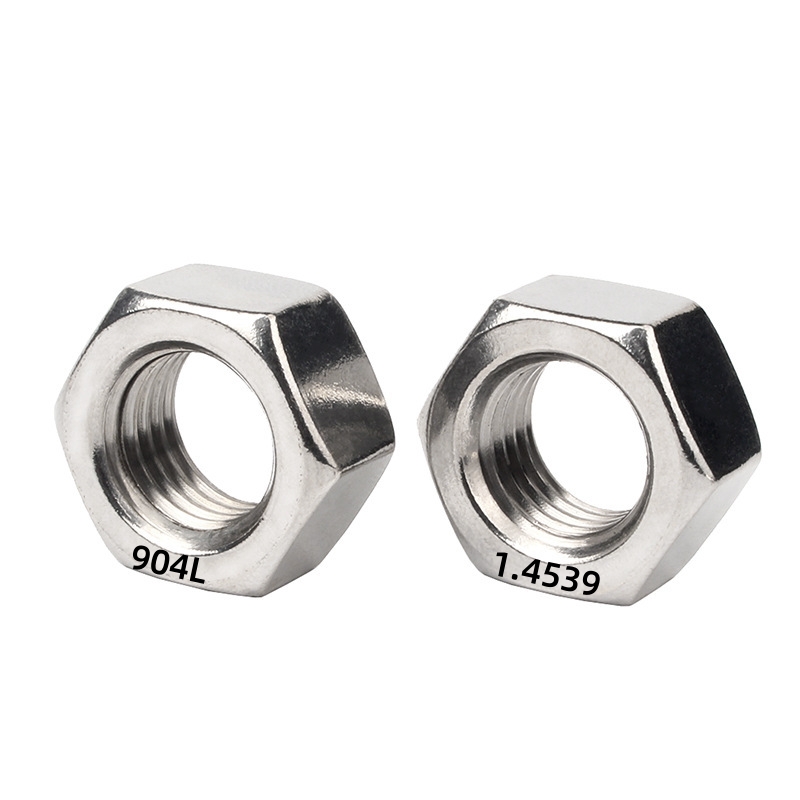
You must evaluate specific metallurgical traits before specifying this fastener. The material excels due to its advanced dual-phase microstructure. It combines austenitic and ferritic phases equally. This balanced structure provides both immense strength and excellent ductility.
Consider its chemical composition carefully. A true Super Duplex 2507 Nut contains roughly 25% Chromium, 7% Nickel, and 4% Molybdenum. This specific blend generates a Pitting Resistance Equivalent Number (PREN) above 42. It delivers superior localized corrosion resistance. The high chromium content forms an impenetrable passive oxide layer. The molybdenum actively fights off localized pitting attacks.
Typical Chemical Composition of Super Duplex 2507 | ||
Alloying Element | Minimum Percentage (%) | Maximum Percentage (%) |
|---|---|---|
Chromium (Cr) | 24.0 | 26.0 |
Nickel (Ni) | 6.0 | 8.0 |
Molybdenum (Mo) | 3.0 | 5.0 |
Nitrogen (N) | 0.24 | 0.32 |
Next, examine the mechanical properties closely. This fastener operates as a formidable high strength nut. It boasts a minimum yield strength of 80 ksi (550 MPa). You can apply significantly higher torque during assembly. You achieve tighter seals on critical flanges. This incredible strength allows engineers to design smaller, lighter bolted joints without sacrificing safety margins.
However, you must respect its thermal limitations strictly. Super duplex alloys suffer from embrittlement at elevated temperatures. You must restrict operational environments to below 315°C (600°F). Above this threshold, a phenomenon known as "475°C embrittlement" occurs. The ferrite phase degrades structurally. The material loses its impact toughness rapidly. It becomes dangerously brittle. We advise checking maximum process temperatures before approving this material.
Engineers frequently debate between standard duplex (2205) and super duplex (2507). Making the right choice requires clear environmental data. You cannot guess process variables. You need exact fluid analysis reports.
Standard duplex 2205 provides excellent baseline protection. It handles moderate chloride levels quite well. It resists SCC much better than 316L. If your system operates below 60°C and avoids highly acidic media, 2205 suffices perfectly. It offers better cost efficiency for these moderate zones. Many onshore wastewater plants use 2205 safely for decades.
The tipping point demands an immediate upgrade. You must specify a Super Duplex 2507 Nut when conditions escalate severely. Higher chloride concentrations trigger this exact need. Extreme subsea depths require enhanced structural integrity. Highly acidic media erode lesser alloys instantly. When fluid pH drops significantly, 2205 loses its passive layer. 2507 maintains its defense mechanisms much longer under these aggressive chemical attacks.
Comparison Chart: Duplex 2205 vs. Super Duplex 2507 | ||
Evaluation Metric | Standard Duplex 2205 | Super Duplex 2507 |
|---|---|---|
PREN Rating | ~35 | > 42 |
Minimum Yield Strength | 65 ksi (450 MPa) | 80 ksi (550 MPa) |
Optimal Environments | Moderate chlorides, neutral pH | Severe chlorides, sour gas, high acidity |
Relative Procurement Cost | Baseline Premium | Advanced Premium |
You must conduct a strict ROI analysis for your projects. Compare the upfront procurement cost of 2507 against the long-term replacement cycle of 2205. Frequent replacements of 2205 in aggressive environments drain your maintenance budgets. You pay for labor, scaffolding, and system downtime repeatedly. The premium 2507 alloy requires a larger initial capital spend. However, it eliminates recurring repair cycles completely. It stabilizes your maintenance forecast.
Heavy industries rely on these premium fasteners for operational survival. Each sector defines success differently based on unique operational hazards. We see three primary industries driving demand.
Offshore & Subsea Oil/Gas: Securing structural joints and subsea pipelines exposes fasteners to brutal conditions. They face constant seawater immersion. They often encounter sour gas containing hydrogen sulfide (H2S). Success criteria here revolve around strict NACE MR0175 compliance. This certification guarantees resistance to sulfide stress cracking. A single subsea fastener failure costs millions to repair.
Desalination Plants (Reverse Osmosis): These facilities process immense volumes of seawater constantly. Fastening high-pressure pumps and piping systems proves highly critical. The concentrated brine reject destroys standard metals quickly. Your success criteria requires zero localized pitting over a 15-year lifecycle. The high strength nut handles extreme brine pressures effortlessly. It prevents catastrophic pump housing leaks.
Chemical Processing: Chemical plants manage volatile substances daily. Environments involve sulfuric, nitric, or hydrochloric acids. Standard threads degrade fast under chemical washdowns. Your success criteria involves maintaining structural integrity safely. You must prevent torque loss over time. You must avoid thread degradation completely to ensure hazardous chemicals remain safely contained.
In all three sectors, under-engineering leads to disaster. Plant managers measure success by counting days without maintenance interventions. Utilizing the correct super duplex grade maximizes these uninterrupted production streaks.
Buying the right material solves only half your engineering problem. You must install it properly and source it safely. Execution matters just as much as specification.
The threat of thread galling remains severe. Cold welding happens frequently during installation. The friction between matching stainless threads causes micro-seizures. The nut locks onto the bolt permanently before reaching full torque. We strongly recommend using premium nickel-based or copper-based anti-seize lubricants. You must follow proper, slow torquing procedures. Never use high-speed impact wrenches on super duplex threads.
Verification and traceability remain non-negotiable requirements. Counterfeit materials flood the global industrial supply chain. Unscrupulous vendors label cheap alloys as 2507. You must demand 100% traceable Material Test Reports (MTRs) before accepting any shipment. Ensure strict compliance against ASTM A815 or ASTM A1014 standards. Check the heat numbers physically stamped on the hardware.
Procurement requires very careful project planning. Specialized alloys face constant supply chain constraints. Follow these specific steps to avoid delays:
Audit your total fastener requirements early in the initial design phase.
Plan batch ordering instead of relying on just-in-time procurement methods.
Expect longer lead times for specific thread pitches or unusual sizes.
Partner directly with certified mills or specialized distributors holding proven track records.
Managing these risks proactively protects your project timeline. It ensures the materials you install perform exactly as your engineering calculations predict.
You must apply shortlisting logic carefully. Recommend Super Duplex 2507 nuts exclusively for environments where high mechanical loads intersect extreme corrosive elements. Do not over-specify them for benign freshwater systems or low-pressure commercial plumbing. Reserve this material for subsea infrastructure, chemical processing, and massive desalination networks.
Take direct action now. Consult a qualified metallurgist or an experienced fastener manufacturer immediately. Review your specific flange specifications closely together. Analyze your exact torque requirements and complex environmental variables. Request an RFQ today to secure your critical infrastructure. Protecting your high-value assets requires decisive, well-informed material selection.
A: We strongly advise against this practice. Mixing these metals creates significant galvanic corrosion risks. The less noble 316 bolt will corrode rapidly in conductive environments like seawater. Additionally, mismatched thermal expansion rates can cause joints to loosen during temperature fluctuations. Always match super duplex nuts with bolts of the exact same grade.
A: You must keep operating temperatures below 315°C (600°F). Exceeding this exact threshold causes the material to suffer from "475°C embrittlement". The ferrite phase in the alloy precipitates rapidly, resulting in a severe loss of impact toughness and ductility. High-temperature applications require nickel alloys instead.
A: You do not need entirely different tools, but you need highly accurate ones. Because it is a high strength nut, you must use calibrated torque wrenches. Impact guns cause severe thread galling. Always apply premium anti-seize paste. Tighten the nuts slowly in a staged star pattern to ensure even clamp load.
A: Super Duplex 2507 serves as an excellent, cost-effective middle ground. It costs significantly more than standard duplex 2205. However, it is much cheaper than ultra-premium nickel alloys like Hastelloy C276 or Inconel 625. If your process temperatures remain below 315°C, 2507 delivers near-nickel-alloy performance at a fraction of the procurement cost.