Please Choose Your Language
close
Choose Your Site
Global
Social Media
Views: 0 Author: Site Editor Publish Time: 2026-08-28 Origin: Site


Boring deep, clean holes in dense or nail-embedded wood requires exceptional tooling. Operators need equipment capable of handling extreme torque and friction without suddenly failing mid-task. Low-grade bits routinely suffer from premature dulling, severe flute deformation, or catastrophic snapping under heavy load. These sudden failures lead to incredibly frustrating project delays, increased safety hazards, and constant tool replacement. Tool longevity directly affects your daily productivity. You simply cannot afford unpredictable equipment downtime on critical jobs. Understanding exact metallurgical properties allows buyers to objectively evaluate tooling based on verifiable physical durability. Precise material selection prevents these frustrating operational bottlenecks entirely. We will deeply explore how specific steel grades and precise heat treatment protocols define high-performance equipment. Ultimately, you will learn exactly how to select reliable tools based on science rather than empty marketing claims.
Poorly manufactured tools fail in highly predictable ways. These failures cause significant damage to your daily workflow. The most common failure modes stem directly from inferior metallurgical properties. You see these frustrating breakdowns constantly on demanding job sites.
These mechanical failures create massive operational disruptions. Workers waste valuable time extracting snapped bits. Removing broken steel from heavy timber proves incredibly difficult. Frequent tool replacements quickly eat into project budgets. Labor downtime easily eclipses the initial savings of cheap equipment. Inferior tools hurt your daily productivity significantly. You simply cannot afford unpredictable tool breakage.
High-performance bits must deliver specific, measurable results. They require sustained edge sharpness over hundreds of bore holes. They must absorb heavy torque during deep drilling phases. They must ensure rapid chip evacuation continuously. Good chip flow prevents dangerous internal overheating. Quality tools push wood chips out quickly. When you invest in true quality, you eliminate common failure points. You secure reliable performance across all your structural projects.
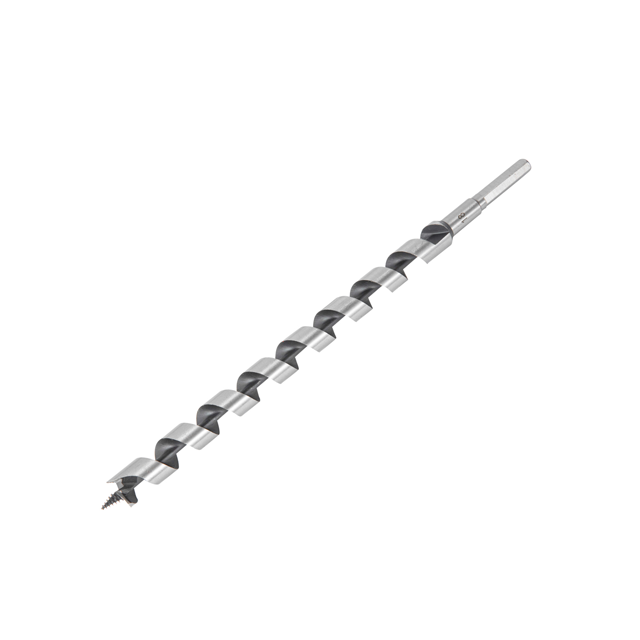
Different boring applications demand specific base materials. We use a straightforward feature-to-outcome framework here. This framework helps you select the right steel quickly. Material choice directly dictates your overall tool lifespan.
High-Carbon Steel represents the standard industry baseline. It offers excellent initial hardness for most tasks. It remains highly cost-effective for general construction needs. You can sharpen it easily in the field. However, it carries distinct and notable disadvantages. It becomes highly brittle if poorly treated. It also loses hardness rapidly at high temperatures. You must monitor heat buildup carefully during deep cuts.
Chrome Vanadium (Cr-V) Alloy provides a significant material upgrade. Manufacturers add precise amounts of chromium and vanadium. This combination increases overall tensile strength dramatically. The addition improves fatigue resistance immensely. It creates exceptional toughness inside the metal structure. You need Cr-V when hitting hidden knots. It works beautifully on dense, unpredictable grain patterns. It absorbs sudden impacts without shattering. Cr-V stands as a premium material choice.
High-Speed Steel (HSS) serves extreme applications exclusively. Most standard wood boring projects do not require HSS. It often proves too expensive for daily carpentry use. However, it excels during extreme friction scenarios. You should choose HSS for nail-embedded lumber exclusively. It boasts incredible heat tolerance under stress. It rarely loses its temper during aggressive drilling. HSS powers through hidden metal fasteners effortlessly.
Table 1: Metallurgical Comparison for Wood Boring Tools
| Base Material | Primary Benefit | Notable Drawback | Ideal Scenario |
|---|---|---|---|
| High-Carbon Steel | Cost-effective and easy to sharpen | Loses temper rapidly at high temperatures | General framing and clean dimensional lumber |
| Chrome Vanadium (Cr-V) | High shock absorption and fatigue resistance | Slightly more expensive than basic carbon steel | Dense hardwoods and knot-heavy timber |
| High-Speed Steel (HSS) | Extreme heat tolerance and edge retention | Cost prohibitive for standard applications | Nail-embedded wood and reclaimed lumber |
Manufacturing processes define structural integrity completely. Proper heat treatment transforms raw steel into highly durable tooling. The primary hardening process initiates this massive transformation. Industry professionals often call this critical step quenching. Facilities heat the steel far above its critical temperature. They then plunge it into rapid cooling mediums. This rapid cooling creates a crystalline structure called martensite. Martensite maximizes the hardness of the cutting lips. It keeps the lead screw aggressively sharp. Your tools need this extreme initial hardness.
However, a fully hardened tool remains functionally useless. The metal will shatter instantly under heavy torque. It possesses zero flexibility or shock absorption. You must understand the vital tempering process next. Tempering involves highly controlled, localized reheating. This secondary process sacrifices slight surface hardness. In exchange, it restores essential flexibility to the internal metal. You need this flexibility to prevent sudden snapping. The steel must bend slightly under immense rotational pressure.
Premium manufacturers rely on differential heat treatment protocols. Industry experts consider this the gold standard approach for Wood Auger Bits. This advanced technique hardens the cutting tip aggressively. It maximizes wear resistance directly at the point of contact. Simultaneously, it leaves the flute and shank noticeably softer. The softer body absorbs extreme drilling torque effectively. It flexes naturally rather than breaking abruptly. This precise metallurgical balance guarantees reliable, long-lasting performance.
You need strict evidence-based criteria for procurement decisions. Buyers must look past heavily polished marketing brochures. You should follow a clear, objective shortlisting logic. We recommend implementing these four mandatory evaluation steps before purchasing bulk tooling.
Even premium tools require proper handling and maintenance. Experience-based guidance maximizes the lifespan of heat-treated equipment. Torque and RPM management remain absolutely critical here. You must understand the relationship between bit diameter and drill speed. Using high RPMs on large augers creates excessive friction. This unchecked friction generates intense, damaging heat. The heat quickly ruins the carefully engineered factory temper. You should always run large diameters at much lower speeds. Wood density also dictates your optimal drilling pace.
Proper sharpening extends tool life significantly. You must follow strict guidelines for hand-filing the cutting edge. Never alter the factory geometry during routine maintenance. You should file only the leading cutting edges. Avoid overheating the steel using motorized bench grinders. Extreme grinding heat destroys the internal heat treatment completely. Hand-filing preserves the metallurgical integrity perfectly. Use a dedicated auger bit file for the best results.
Application matching prevents catastrophic tool failure. Standard tools handle clean, dimensional lumber exceptionally well. However, project risks often change unexpectedly on site. You must know exactly when to switch equipment. Move to a specialized nail-chipper for reclaimed wood. Choose a heavy-duty ship auger for deep utility poles. Using the right tool prevents unnecessary breakage. It protects your equipment investment entirely.
Tool durability remains exclusively a product of metallurgical science. Excellent steel grades combined with precise heat treatment guarantee success. You simply cannot fake physical durability. We highly advise all buyers to prioritize complete transparency. Demand clear HRC ratings from every manufacturer. Request exact alloy compositions before signing purchasing contracts. Avoid purely price-driven procurement decisions at all costs. Cheap tools always cost more in the long run. Take decisive action today regarding your procurement. Audit your current tooling failure rates thoroughly. Identify exactly where breakages occur most frequently. Contact technical sales professionals for custom tooling recommendations. Request a sample trial to verify performance firsthand.
A: Yes, they frequently do. Wood acts as a powerful natural insulator. It traps thermal energy rather than dissipating it. In metalworking, ejected chips carry the heat away from the tool. Wood chips do not transfer heat efficiently. This means the bit retains significantly more heat during operation. This intense thermal retention makes precise heat treatment absolutely critical for wood boring tools.
A: The optimal range falls exactly between 50 and 58 HRC. This specific target provides the perfect metallurgical balance. It holds a sharp cutting edge effectively over time. Simultaneously, it maintains enough internal ductility to flex safely under heavy loads. Tools exceeding 58 HRC risk severe brittleness and shattering. Tools below 50 HRC suffer from rapid, unacceptable wear.
A: While theoretically possible in a controlled forge, it remains highly impractical. It is never cost-effective for everyday end-users. Proper heat treatment requires extremely precise, localized temperature controls. Handheld torches cannot replicate factory differential tempering safely. Replacing the damaged bit serves as the standard operational procedure. It guarantees safety and predictable performance.